Friday, August 16, 2024

The best site for downloading torrents

0 comments

 I came upon Seedr.cc, which is a very useful service for downloading torrent files.


https://www.seedr.cc/

It is always free and will remain so.

You simply need to go to the website and make an account.

You can also do it with your Google account.

You will receive 2GB of free storage with your account, which can be expanded by completing certain simple activities on the website. Premium memberships are also available in a variety of options.


You have the option of copying the torrent link or uploading the torrent file to your account. It will then offer you with a direct link to download the file.


Seedr will be required for the following reasons:


-Continuous streaming of videos, music, and also instructions of any kind


-With best-in-class streaming technologies, Seedr allows you to watch videos, listen to music, and learn stuff from your BitTorrent library in the cloud on any device.


-Non-public, as well as secure.


-Seedr employs high-level carry encryption to protect your privacy, and there's no need to be concerned about malware, viruses, or outside threats because Seedr is the filter that protects you.


-Very quick.


-Seedr uses a high-speed spinal and may send torrents to the cloud in a matter of minutes as a result of a series of events.


https://www.seedr.cc/

I happened onto this fantastic torrent downloader by chance. It's amusing that I was browsing for seeds (the kind used in farming) when I came across this "seed."

I'd name this seed because it grows into a large and magnificent tree all you have to do is plant it (copy-paste the magnetic link) (the downloaded content). I was fed up with all of the downloading issues I was having because several sites other than seedr offered this service, but my data was limited and I couldn't download, and torrent takes too long to download stuff with a small number of seeds, so this was a lifesaver for me.


Any device can stream movies, music, and books.

Seedr's best-in-class streaming technology lets you view movies, listen to music, or read anything from your torrent collection on any device directly from the cloud.

Secure and private

Seedr protects your privacy with high-level transport encryption, and you don't have to worry about malware, viruses, or outside tracking because Seedr is the barrier between you and the outside world.

Seedr relies on a high-speed backbone and can retrieve torrents to the cloud in a matter of minutes, if not seconds.


If you've ever tried to use torrents on a tablet or phone, you'll immediately realize how inconvenient it is. Seedr is the answer: using specific mobile-friendly protocols, we built a snappy, quick mobile site with all of the same features as the desktop version, including streaming, subtitles, and high-speed direct downloads.

We believe that torrent downloads can be made friendlier and safer, and we intend to extend the site's already extensive functionality in the near future.


https://www.seedr.cc/

Overall

Seedr's charm resides in its simplicity, which makes it far easier to use than uTorrent. It's difficult to see anyone needing to use the site's lesson other than utter beginners. Those who do will not be disappointed, as it demonstrates how to integrate the service with Kodi/XBMC.


Aside from the free tier (which is a value), the service isn't inexpensive at $9.95 per month (two months free on annual rates), thus it could benefit from a more limited lower-tier premium plan around the $6 to $7 area.

Seedr knows its target demographic and appears to serve them well. Those that stress over the details of their torrenting might prefer a full-fledged seedbox experience, but Seedr knows its target audience and looks to serve them well.

Seedr can be tried for free here.


https://www.seedr.cc/

Sunday, August 16, 2009

Search Engine Optimization

0 comments

The Good and the Bad of SEO ’s From Google’s Mouth!

I recently had the opportunity to ask questions of some Google staffers. There were some questions I felt I needed to get verification on, so when I had the opportunity via a conference call I took it.

In this article I highlight some of the points made during the call so you know what Google thinks.

You know its bad when you take time from your holidays to come into work to attend a conference call. But that’s what I did a few weeks ago. You see I had to because I was going to have the opportunity to ask some Google employees specific questions on things that I’d been pretty sure about, but wanted to hear it right from the horses mouth.

The call lasted less than an hour, but in that time I found that there were many things I figured were indeed true. So lets start with the most obvious:

Is PageRank still important?

The short answer is yes� PageRank has always been important to Google. Naturally they couldn’t go into details but it is as I suspected. Google still uses the algorithm to help determine rankings. Where it falls in the algo mix, though, is up for speculation. My feeling however is that they’ve simply moved where the PageRank value is applied in the grand scheme of things. If you want to know what I think, be sure to read this article.

Are dynamic URLs bad?

Google says that a dynamic URL with 2 parameters should get indexed. When we pressed a bit on the issue we also found that URLs themselves don’t contribute too much to the overall ranking algorithms. In other words, a page named Page1.asp will likely perform as well as Keyword.asp.

The whole variable thing shouldn’t come as a surprise. It is true that Google will indeed index dynamic URLs and I’ve seen sites with as many as 4 variables get indexed. The difference however is that in almost all cases I’ve seen the static URLs outrank the dynamic URLs especially in highly competitive or even moderately competitive keyword spaces.

Is URL rewriting OK in Google’s eyes?

Again, the answer is yes, provided the URLs aren’t too long. While the length of the URL isn’t necessarily an issue, if they get extremely long they can cause problems.

In my experience, long rewritten URLs perform just fine. The important thing is the content on the page.

That was a common theme throughout the call� content is king. Sure optimized meta tags, effective interlinking and externalizing JavaScript all help, but in the end if the content isn’t there the site won’t do well.

Do you need to use the Google Sitemap tool?

If your site is already getting crawled effectively by Google you do not need to use the Google sitemap submission tool.

The sitemap submission tool was created by Google to provide a way for sites which normally do not get crawled effectively to now become indexed by Google.

My feeling here is that if you MUST use the Google sitemap to get your site indexed then you have some serious architectural issues to solve.

In other words, just because your pages get indexed via the sitemap doesn’t mean they will rank. In fact I’d bet you that they won’t rank because of those technical issues I mentioned above.

Here I’d recommend getting a free tool like Xenu and spider your site yourself. If Xenu has problems then you can almost be assured of Googlebot crawling problems. The nice thing with Xenu is that it can help you find those problems, such as broken links, so that you can fix them.

Once your site becomes fully crawlable by Xenu I can almost guarantee you that it will be crawlable and indexable by the major search engine spiders. Download it from http://home.snafu.de/tilman/xenulink.html

Does clean code make that much of a difference?

Again, the answer is yes. By externalizing any code you can and cleaning up things like tables you can greatly improve your site.

First, externalizing JavaScript and CSS helps reduce code bloat which makes the visible text more important. Your keyword density goes up which makes the page more authoritative.

Similarly, minimizing the use of tables also helps reduce the HTML to text ratio, making the text that much more important.

Also, as a tip, your visible text should appear as close to the top of your HTML code as possible. Sometimes this is difficult, however, as elements like top and left navigation appear first in the HTML. If this is the case, consider using CSS to reposition the text and those elements appropriately.

Do Keywords in the domain name harm or help you?

The short answer is neither. However too many keywords in a domain can set off flags for review. In other words blue-widgets.com won’t hurt you but discount-and-cheap-blue-and-red-widgets.com will likely raise flags and trigger a review.

Page naming follows similar rules ‘ while you can use keywords as page names, it doesn’t necessarily help (as I mentioned above) further, long names can cause reviews which will delay indexing.

How many links should you have on your sitemap?

Google recommends 100 links per page.

While I’ve seen pages with more links get indexed, it appears that it takes much longer. In other words, the first 100 links will get indexed right away, however it can take a few more months for Google to identify and follow any links greater than 100.

If your site is larger than 100 pages (as many are today) consider splitting up your sitemap into multiple pages which interlink with each other, or create a directory structure within your sitemap. This way you can have multiple sitemaps that are logically organized and will allow for complete indexing of your site.

Can Googlebot follow links in Flash or JavaScript

While Googlebot can identify links in JavaScript, it cannot follow those links. Nor can it follow links in Flash.

Therefore I recommend having your links elsewhere on the page. It is OK to have links in flash or JavaScript but you need to account for the crawlers not finding them. Therefore the use of a sitemap can help get those links found and crawled.

As alternatives I know there are menus which use JavaScript and CSS to output a very similar looking navigation system to what you commonly see with JavaScript navigation yet uses static hyperlinks which crawlers can follow. Therefore do a little research and you should be able to find a spiderable alternative to whatever type of navigation your site currently has.

Overall, while I didn’t learn anything earth shattering, it was good to get validation “from the horses mouth so to speak.

I guess it just goes to show you that there is enough information out there on the forums and blogs. The question becomes determine which of that information is valid and which isn’t. But that, I’m afraid, usually comes with time and experience.


Sunday, August 9, 2009

Yet Another Process Monitor Manages Running Tasks

0 comments
Windows only: System monitoring utility Yet Another Process Monitor is not just a powerful way to see what's going on under the hood—it's also portable


Once you've


downloaded and extracted the no-installation-required software, you can put it on a flash drive or take it anywhere you'd like—so long as the target system has .NET Framework 2.0 installed. The utility can do everything you'd expect from a process manager, including a nice option to right-click a process and search the internet for more information.

There are plenty of more powerful features for the more tech-savvy, like detecting hidden processes, monitoring remote machines, and even viewing the memory of a process in a hex editor. Yet Another Process Monitor is free and open source, available for 32-bit Windows systems only.


Windows 7 upgraders guide: The simple version

0 comments


Microsoft released a nice, big chart the other day which details the many possible ways of moving from your existing Windows OS to Windows 7. It's got a slight case of information overload, however, so let's simplify things a bit. After all, not everyone reading Download Squad is an IT director with years of experience.


First, let's spell out the important terms.

In-Place Upgrade: means one you can run from your current Windows desktop. If f you currently own a laptop or desktop with Windows Vista Home Premium you will be able to boot up your computer as normal, pop in your Windows 7 Home Premium disk, and upgrade Windows. Your existing data (music, pictures, etc.) and programs are automatically moved.

Custom Install: "Custom" here really means "new," "fresh," or "clean." When you finish installing Windows your new desktop will be pretty bare - none of your old programs of data will be there, so you'll need to back them up first. Custom installs can't be performed from your existing Windows desktop. You have to force your system to boot from the Windows 7 DVD instead.


Friday, August 7, 2009

Free FLV Player To Display Videos In Websites

0 comments

FLV Player is an open source & free resource to display FLV files on websites.

It is compatible with FLV version 1.1 & comes in 5 types:

  • mini: player with a start/pause button & timeline control
  • normal: mini + stop button
  • maxi: normal + sound & fullscreen buttons
  • multi: maxi + multiple video display option
  • JavaScript: a player with no graphical interface but can be totally controlled via JS

The player can be controlled with keyboard for a better accessibility.

Download links can be found inside the "details" page of each player version.


Thursday, August 6, 2009

Arora: A light-weight, cross-platform web browser based on WebKit

0 comments


Arora is an open source
web browser that uses the same WebKit rendering engine found in Safari
and Google Chrome. But unlike those browsers, Arora is already capable
of running on Windows, Linux, and OS X, as well as a few other
platforms including FreeBSD.

That's because Arora is built to
work on any platform that supports the Qt toolkit.

The
browser has a couple of features that are all the rage with the kids
these days, including full page zoom (as opposed to text-only zooming),
and a private browsing mode that will let you surf without saving any
cookies or other personal data to the hard drive. It's also relatively
light on system resources, and boots and loads web pages reasonably
quickly.


Wednesday, August 5, 2009

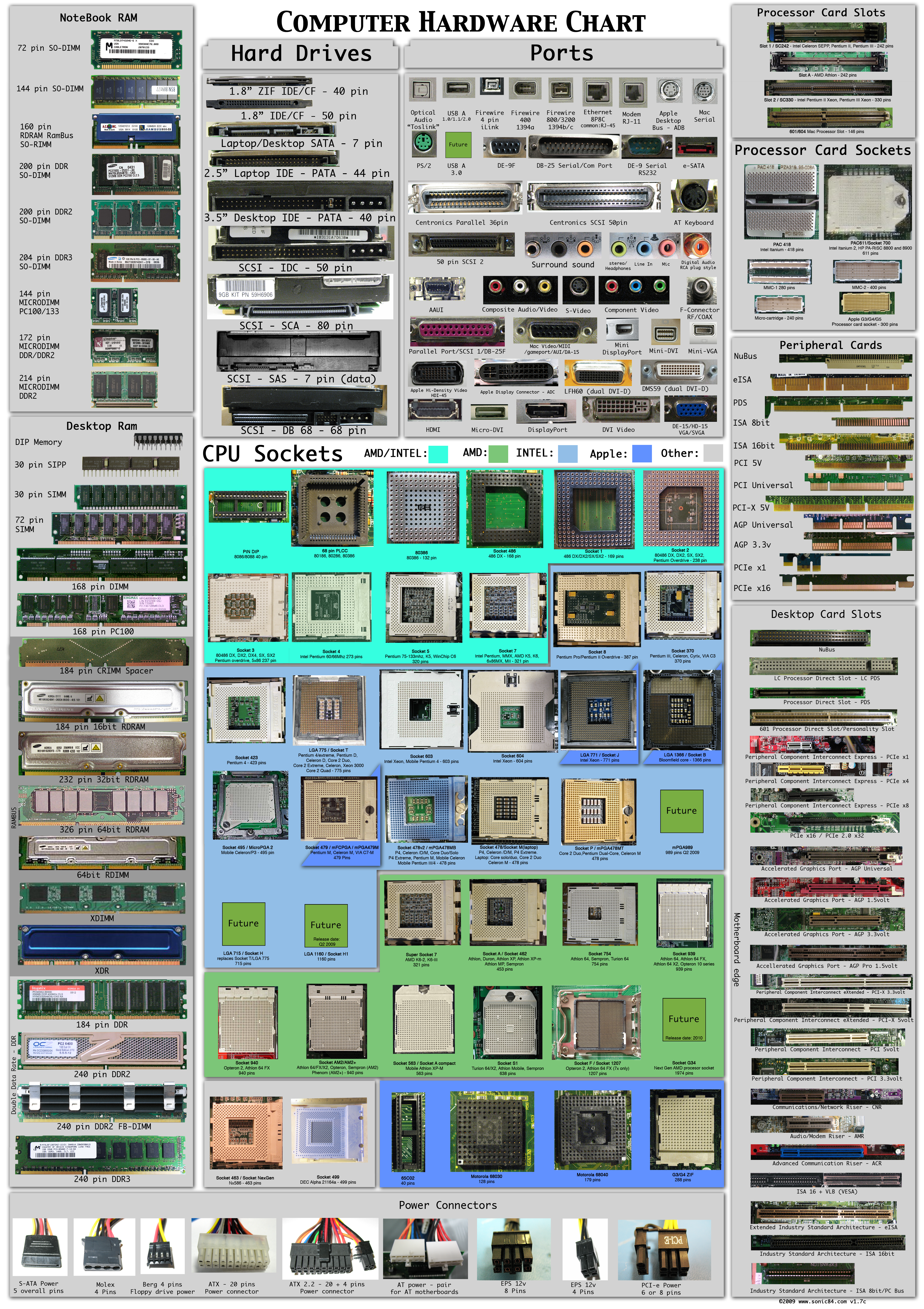
Computer Hardware Poster

1 comments

This will be very useful for a newbie to identify Computer hardware peripherals.It is clearly differentiate different parts of the computer. Click on the image to enlarge.


Copyright 2008 All Rights Reserved Revolution Two Church theme by Brian Gardner Converted into Blogger Template by Bloganol dot com